

Table of Contents
- Home Workout Equipment for Small Spaces: What Actually Fits
- Compact Home Gym Equipment: Strength Picks That Save Floor Area
- Small Exercise Machines for Home: Cardio Without the Bulk
- Portable Workout Equipment: Train Anywhere, Store Anywhere
- Foldable Exercise Equipment: Storage, Setup Time, and Maintenance
- Noise, Vibration, and Keeping the Neighbours on Side
- Matching Home Workout Equipment to Your Budget and Fitness Level
- Conclusion: Build the Small-Space Home Gym That Sticks
- Frequently Asked Questions
Last Updated: October 9, 2026
Home Workout Equipment for Small Spaces: What Actually Fits
Fitting home workout equipment for small spaces comes down to one habit: measure the floor you actually have before you buy, then choose gear that stores vertically or folds flat.
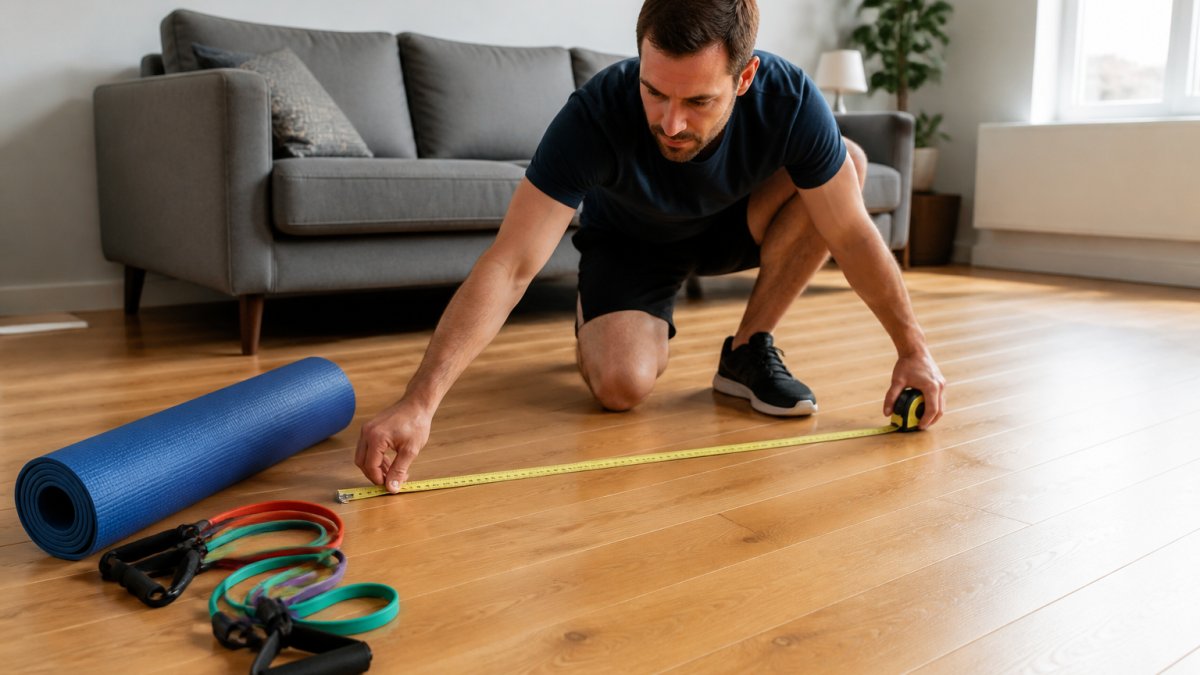
Most home workout equipment is designed for a spare room, not a flat. The gear that works in a small flat lives against a wall, under a bed or behind a door when not in use.
If you want the short version: a mat, a set of resistance bands, one pair of adjustable dumbbells and a foldable bench will cover almost every strength and mobility session you can do at home.
Measure First: A Room-by-Room Sizing Checklist
A room-by-room sizing check takes about fifteen minutes and saves you from buying equipment that never leaves its box. Note the clear floor area, not the total room size.
- Living room: measure the clear floor between sofa and wall. You need roughly 2m x 1m for a mat-based session.
- Bedroom: check the gap beside the bed and the height under it for flat storage.
- Hallway or landing: note door swing clearance before considering a pull-up bar.
- Spare room or office: measure wall height for anything that mounts or leans.
- Storage: count cupboard, wardrobe and under-bed space for folded equipment.
Two rules matter most: leave a 60cm walkway so the room still works as a room, and measure ceiling height before buying anything that stands upright.
Compact Home Gym Equipment: Strength Picks That Save Floor Area
Compact home gym equipment for strength comes down to three categories covering nearly every movement: adjustable dumbbells, kettlebells and resistance bands. Together they take less space than a single fixed-weight rack.
Adjustable Dumbbells, Kettlebells, and Resistance Bands
Adjustable dumbbells replace an entire rack of fixed weights with one pair that dials between loads. A full set needs a rack the size of a small armchair; one adjustable pair fits in a shoebox-sized footprint.
Kettlebells suit swings, goblet squats and carries, and one mid-weight bell covers plenty for a beginner. Resistance bands with a door anchor handle pulling movements dumbbells cannot replicate without a bench and rack. A suspension trainer adds rows and presses using a door, though you must check the anchor and frame first.
| Equipment | Floor Space | Storage | Best For |
|---|---|---|---|
| Adjustable dumbbells | Under 0.5 sq m | Beside a wall or under a bed | Progressive strength training |
| Kettlebell (single) | Under 0.3 sq m | Corner or cupboard | Swings, squats, carries |
| Resistance bands | None while stored | Drawer or hook | Pulling movements, mobility |
| Suspension trainer | None while stored | Door frame hook | Rows, presses, core work |
The most common mistake is buying fixed dumbbells first because they feel simpler. They are not, once you need a second and third weight and the floor space disappears.
Small Exercise Machines for Home: Cardio Without the Bulk
Small exercise machines for home only work if they fold, but the folded size is rarely what matters.
A folding treadmill suits walkers and runners who want incline work.
A folding exercise bike is quieter, lighter and easier to reposition. Expect roughly 1m by 50cm in use, folding to a depth of 40cm to 50cm, at 15kg to 30kg.
A rowing machine gives a full-body workout and stores upright against a wall, but it is the longest machine in use.
A cross trainer or elliptical is the hardest to place in a flat. Most models are tall and wide, rarely fold, and need around 1.5m to 1.8m of length with similar height clearance.
| Machine | Footprint in use | Folded / stored | Typical weight | Noise on hard floor |
|---|---|---|---|---|
| Folding treadmill | ~1.2-1.5m x 60-75cm | ~1.5-1.7m tall, 60-80cm deep | 40-70kg | Highest |
| Folding exercise bike | ~1m x 50cm | ~40-50cm deep | 15-30kg | Low |
| Rowing machine | ~2.1-2.4m long | ~50cm x 60cm upright | 25-40kg | Moderate |
| Cross trainer | ~1.5-1.8m long | Rarely folds | 40-70kg | Moderate |
Those figures are typical ranges, not guarantees, because models vary. The pattern is the point: the machine that folds smallest is not always the one that takes up least room while in use.
If noise or length is your main constraint, the bike wins. If you want the widest range of training from one machine and have the length to spare, the rower is the better investment. Buy a treadmill only when you have both the floor space and a floor structure that can take the impact.
Portable Workout Equipment: Train Anywhere, Store Anywhere
Portable workout equipment is gear you can carry in one hand and store in a drawer, and it covers more of a training programme than most people expect: a jump rope, exercise bands, ankle and wrist weights, a foam roller and push-up stands.
This category gives beginners the best return. A jump rope handles cardio in a hallway, bands and a door anchor cover pulling, a foam roller handles recovery, and push-up stands add range while taking strain off your wrists.
Portable gear also solves the noise problem. A jump rope on a mat is far quieter than a treadmill, and bands make no noise at all. If you live above someone, build your programme around this category first and add machines later.
Foldable Exercise Equipment: Storage, Setup Time, and Maintenance
Foldable exercise equipment only earns its place if setup takes under two minutes, because anything slower becomes a reason not to train. Before buying, estimate the fold and unfold time, then add the time to move it into position.
Maintenance is the part buyers overlook. Folding mechanisms have hinges, pins and latches that collect dust and loosen over time. Check them monthly, keep joints clean, and store the item dry, a folding bench under a bed in a damp room will not last as long as one kept in a cupboard.
Setup time by category, as a rough guide:
- Resistance bands and jump rope: under 30 seconds
- Adjustable dumbbells: under 30 seconds
- Folding bench: one to two minutes
- Folding bike: one to two minutes
- Folding treadmill: two to three minutes
If a piece of equipment sits above the three-minute mark, it will mostly stay folded.
Noise, Vibration, and Keeping the Neighbours on Side
Noise and vibration are the two reasons small-space home gyms fail in flats, and almost no buying guide addresses them properly.
Start with the floor. A thin foam yoga mat is a comfort layer, not a vibration barrier.
For dumbbells, use rubber-coated or adjustable sets and set them down rather than dropping them, even a controlled set-down from waist height thuds through a timber floor.
For cardio, the machine choice matters more than the mat. A folding exercise bike is quietest, with almost no impact noise.
Timing matters as much as gear. Most tenancy agreements and leases include quiet hours, often between 11pm and 7am, though terms vary.
A practical decision order for anyone living above someone:
- Silent first: resistance bands, bodyweight work, a folding bike.
- Moderate next: a rowing machine, a foam roller, adjustable dumbbells set down carefully.
- Impact last: a treadmill, a jump rope on bare boards, dropped weights.
If you must train with impact equipment, do it on a dense rubber mat, keep sessions reasonable, and train within sociable hours.
Matching Home Workout Equipment to Your Budget and Fitness Level
Matching equipment to your budget and level means buying in stages, starting with the gear that covers the most movements for the least money. The right order is mobility and bodyweight first, strength second, cardio last.
For a beginner, start with a mat, a band set with a door anchor and one kettlebell, a full-body workout that stores in a cupboard.
For an intermediate trainee, add a folding bench and a second kettlebell or heavier band set.
At KEYFAITH Stores, our range includes yoga sets and abdominal wheels designed for exactly this kind of compact setup.
The honest limitation: budget gear and premium gear often look identical online. For guidance on safe training loads and technique, the NHS fitness and exercise guidance is a sensible starting point.
Conclusion: Build the Small-Space Home Gym That Sticks
The equipment that survives in a small space is what you can set up in under two minutes and store without rearranging the room. Buy in stages, start with bands and a mat, and add machines only once you have measured the space and the noise will not cause a problem.
At KEYFAITH Stores, we stock practical fitness gear for exactly this situation, including yoga sets, resistance equipment and abdominal wheels that fit a cupboard rather than a spare room. Browse the range, measure your space first, and build a setup you will actually use.
Frequently Asked Questions
What is the best home workout equipment for a small space?
The best picks are the ones that store flat or stack: adjustable dumbbells, resistance bands with a door anchor, a suspension trainer, and a foldable bench. These cover strength training for the whole body without eating floor space. Add one compact cardio option such as a jump rope or folding stationary bike if you want a full-body workout. Measure your available floor area in centimetres before buying, and favour equipment that folds to under 30 cm deep so it slides behind a sofa or into a wardrobe.
Can you get an effective workout with compact home gym equipment?
Yes. Progressive strength training depends on increasing resistance and range of motion, not on machine size. Adjustable dumbbells, kettlebells, and resistance bands let you add load in small increments, which is exactly what drives progress. A 30-minute session combining squats, presses, rows, and core work covers every major muscle group. The limitation is heavy barbell lifts, so if you want to squat over 100 kg you will need a rack, which most flats cannot accommodate.
What exercise equipment is easiest to store?
Resistance bands, a jump rope, a suspension trainer, and a foam roller take up almost no room and hang on a hook or fit in a drawer. Foldable exercise equipment such as a folding bench or a compact rowing machine is the next step up, usually folding to 20-40 cm deep. Wall-mounted or door-mounted pull-up bars store flat against the frame. Avoid fixed benches, treadmills, and large cross trainers unless you have a dedicated room, as these rarely fold and take up permanent floor area.
How do I choose workout equipment for a flat with limited storage?
Start with the dimensions, not the features. Write down the longest wall, the gap behind your sofa, and the height of your wardrobe shelf in centimetres. Then shortlist only equipment that fits those measurements when folded or deflated. Prioritise multi-purpose items over single-use machines, check the assembled and folded weight so you can move it alone, and confirm the load limit on any door anchor or pull-up bar before you rely on it. Storage and setup time matter more than spec sheets in a small flat.
Is home workout equipment suitable for beginners in their forties?
Entry-level gear suits beginners at any age because resistance is adjustable. Start with light dumbbells, a long resistance band, and a mat, and focus on form before load. Bodyweight training, such as push-up stands and assisted squats, builds a base without stressing joints. Progress by adding repetitions or a slightly heavier band rather than jumping to heavy weights. If you have an existing injury or joint condition, speak to a GP or physiotherapist before starting a new routine.
Building a home gym in a small flat rarely fails because of the equipment. It fails because the setup takes too long and the space never quite worked. KEYFAITH Stores offers compact fitness gear, from yoga sets to abdominal wheels, alongside household and lifestyle products for the same rooms. Start with the pieces that fit your floor, your storage and your routine, and add to them as you go.