

Table of Contents
- Why Compact Yoga Gear Matters for Home Practice
- Essential Compact Yoga Mat: Dimensions and Storage
- Yoga Blocks for Home: Support Without the Space
- Space-Saving Yoga Equipment That Works
- Choosing a Yoga Starter Kit for Beginners
- Storage Solutions and Organisation Tips
- Common Mistakes When Buying Home Yoga Gear
- Frequently Asked Questions
Last Updated: October 11, 2026
Why Compact Yoga Gear Matters for Home Practice
Buying compact yoga gear for home is no longer a nice-to-have for fitness enthusiasts. It's become essential for anyone serious about maintaining a regular practice in limited space. The reality is simple: most homes aren't designed for sprawling fitness equipment, and bulky gear often ends up gathering dust in a cupboard rather than supporting your routine.
Remote workers, busy professionals, and anyone juggling multiple commitments now prioritise compact yoga gear that fits their actual living situation. Space constraints aren't an excuse to skip practice, they're a reason to be smarter about what you choose.
The challenge is finding compact yoga gear that doesn't compromise on quality or functionality: mats that grip properly, blocks that won't crumble, and everything that fits in a cupboard or under a bed.
Essential Compact Yoga Mat: Dimensions and Storage
Dimensions and rolled size
Standard mats measure 173cm by 61cm. For flats or shared homes, look for mats between 160-170cm in length and 55-60cm in width, enough room for most poses while fitting in a hallway cupboard or under a bed.
A rolled mat's footprint depends on thickness and material. A 4mm TPE mat rolls to roughly 25cm long and 8cm diameter. A 6mm natural rubber mat rolls to about 28cm long and 10cm diameter. An 8mm PVC mat reaches 35cm long and 12cm diameter. That 10cm difference matters significantly in limited storage.
Weight matters for portability. TPE mats weigh 0.8-1.2kg, natural rubber 1.5-2kg, and PVC often exceeds 2kg. If you move your practice between rooms or travel occasionally, lighter TPE is practical despite natural rubber's durability advantage.
Material trade-offs for small-space storage
Material choice affects not just storage size but how gear performs and lasts in a confined environment.
TPE (thermoplastic elastomer): Lightweight, rolls compactly, resists odours, and grips well. Drawback: less cushioning than natural rubber, and grip diminishes after 1-2 years. Best for: practitioners in small spaces who move their mat frequently.
Natural rubber: Excellent grip, superior cushioning, lasts 3-5 years. Drawback: heavier, takes more space when rolled, requires occasional cleaning to prevent odour. Best for: practitioners committed to a single location who prioritise durability over portability.
PVC: Affordable but heaviest, takes most storage space, and can off-gas odours. Not recommended for small-space storage unless budget is the only constraint.
Thickness: cushioning versus compactness
Thinner mats (3-4mm) roll tighter and weigh less, ideal for storage. They work well for gentle stretching and mobility. Drawback: minimal cushioning for knees and hips in longer holds.
Mid-range mats (5-6mm) balance cushioning and portability, the sweet spot for small-space living.
Thicker mats (8mm+) provide excellent cushioning for restorative practice. Drawback: they roll to 35cm+ long and 12cm+ diameter, which may not fit under a bed.
Storage and care in small spaces
Store mats in cool, dry cupboards or under beds. Avoid damp areas under sinks and hot attics.
Roll mats loosely to prevent permanent creases. Store horizontally on a shelf or vertically in a yoga bag to prevent warping.
In poorly ventilated spaces, choose TPE or natural rubber over PVC. Wipe your mat after practice and air dry fully before rolling to prevent mildew.
Yoga Blocks for Home: Support Without the Space
Yoga blocks are the most underrated piece of compact yoga gear for home practice. Blocks make poses more accessible, reduce injury risk, and take up almost no storage space.
A standard yoga block measures 23cm by 15cm by 10cm and weighs 200-300 grams. Cork blocks are durable and grip well; foam blocks are cheaper but compress over time. For home practice, cork offers better long-term value.
Blocks modify poses to match your flexibility and strength. A block brings the floor to you in forward folds and helps maintain alignment in shoulder work, preventing frustration that stops many people from practising consistently.
Store blocks vertically on a shelf or horizontally under a sofa. They're compact enough that storage rarely becomes an issue. What matters is having them accessible so you actually use them rather than letting them sit unused in a cupboard.
Space-Saving Yoga Equipment That Works
Beyond mats and blocks, the best space-saving equipment serves multiple purposes. Resistance bands work for stretching, strengthening, and mobility, taking up barely any space.
The 13-Piece Yoga & Pilates Set from KEYFAITH Stores demonstrates this principle well. At just 12 x 5 x 10 centimetres when packed, it includes a stretching strap, resistance bands, a yoga ring, a pilates ring, a yoga ball, non-slip socks, and a gym bag, all designed for full-body training without requiring dedicated floor space. The lightweight materials (PP and TPE) mean you can move everything in seconds, and the included bag keeps everything organised and portable.

Yoga straps weigh almost nothing and fold into a pocket-sized bundle. They support deeper stretches, help with alignment, and work for both floor-based and standing poses.
Resistance bands strengthen muscles that yoga alone won't build. Loop bands and therapy bands pack down to almost nothing and fit in any drawer.
Choosing a Yoga Starter Kit for Beginners
A yoga starter kit saves money and eliminates decision paralysis, but the right kit depends on your practice style, available space, and budget.
Budget-tier guidance
Entry-level (£30-£50): Kits at this price typically include a basic mat (often PVC), one foam block, and a strap.
Premium (£100-£200): Kits at this level feature natural rubber mats, cork blocks, premium straps, and often include extras like yoga bolsters, eye pillows, or meditation cushions.
Choosing by practice style
Your intended practice style should shape which kit components matter most.
Gentle stretching and mobility: Prioritise cushioning and support. Look for kits with thicker mats (6mm+), multiple blocks (at least two), and a strap. Resistance bands are less critical.
Vinyasa or flow-based practice: Prioritise grip and lightweight portability. Look for kits with TPE mats (lighter, better grip than PVC), at least one block, and a strap.
Restorative or yin yoga: Prioritise cushioning and support props. Look for kits with thicker mats, multiple blocks, bolsters if available, and a strap. Weight and portability matter less.
Space-conscious kit selection
Before buying, check the packed dimensions of the entire kit, not just individual items. Some kits claim to be "compact" but pack into a bag the size of a large rucksack.
Measure your intended storage space: under-bed clearance, cupboard shelf depth, or available floor corner. Compare that to the kit's folded or rolled footprint.
Look for kits that include a sturdy storage bag or box. Cheap bags split after a few weeks of regular use.
Quality markers to check
For beginners, durability matters more than advanced practitioners realise. A slippery mat or crumbling blocks will discourage you from practising.
Mat grip: Check product reviews or descriptions for non-slip surface. TPE and natural rubber mats grip better than PVC.
Block material: Cork blocks last 3-5 years and provide excellent grip. High-density foam blocks last 1-2 years with regular use. Compressed foam blocks (the cheapest option) often crumble within months.
Strap quality: Cotton straps should be at least 5cm wide and reinforced at stress points. Thin straps (2-3cm) fray quickly. Check that buckles or D-rings are metal, not plastic.
Mat thickness and weight: A mat thinner than 3mm offers minimal cushioning. A mat heavier than 2kg becomes a barrier to regular practice if you're moving it between rooms.
The complete beginner kit essentials
If a kit omits any of these three core items (mat, block, strap), you'll end up buying them separately anyway, negating the bundle savings.
Start with the essentials. Add to your kit gradually as you discover what genuinely supports your practice, whether that's a second block, a bolster, or additional resistance bands.
Storage Solutions and Organisation Tips
Storage is where most home yoga gear fails. Equipment ends up scattered because there's nowhere convenient to keep it. Solving this before you buy makes the difference between a consistent practice and abandoned gear.
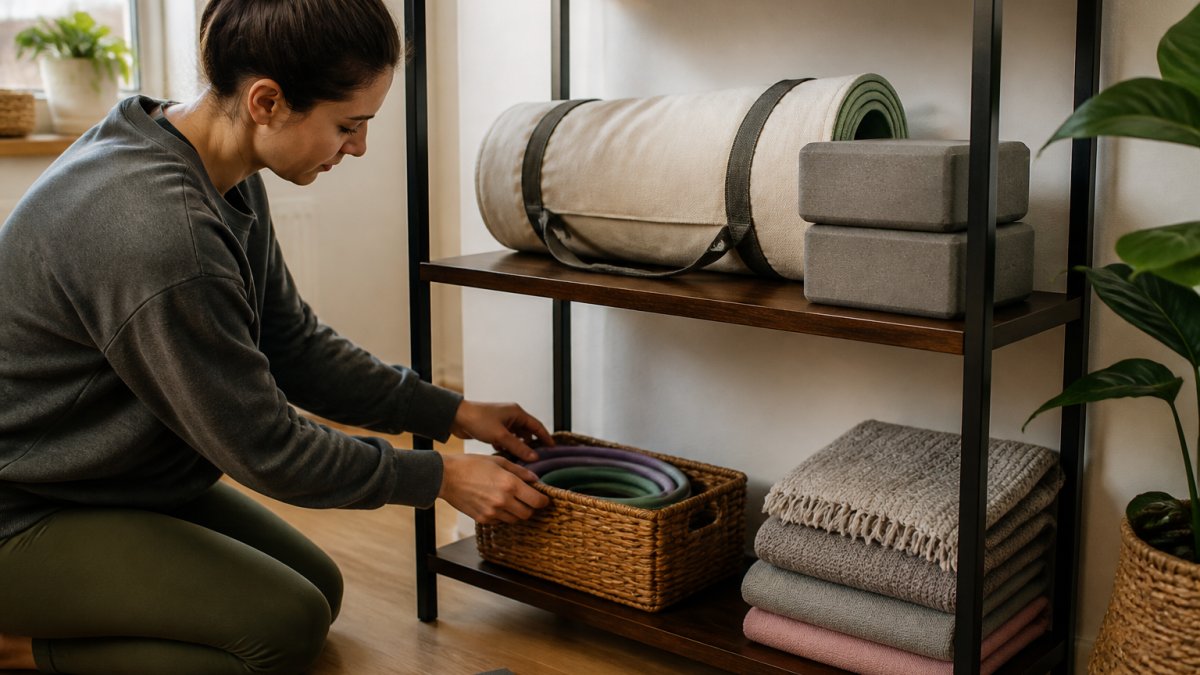
The simplest solution is a designated yoga bag or storage box. Keep everything in one place so you grab it all at once. A gym bag like the one in the KEYFAITH 13-Piece Set is durable, portable, and sized to fit in a cupboard.
Vertical storage saves space. Wall-mounted shelves hold blocks and rolled mats. A tension rod in a cupboard holds rolled mats horizontally. Drawer organisers keep smaller items from tangling.
Label everything if you share space with others. A simple tag on your yoga bag prevents confusion and makes it easier to grab your gear.
Consider climate when storing gear long-term. Damp cupboards under sinks can damage mats and cause mould. Attics that get very hot may degrade rubber and foam faster. A cool, dry cupboard or under-bed storage works best. Mats stored in bags should be rolled loosely rather than tightly packed, tight rolling can create permanent creases.
Common Mistakes When Buying Home Yoga Gear
Most people make predictable errors when shopping for compact yoga gear, and correcting them saves both money and frustration.
The first mistake is prioritising price over durability. A £15 mat may tear after three months or provide so little grip that you worry about slipping. Spending more upfront on quality equipment means your gear lasts years rather than months.
The second mistake is buying too much at once. You need a mat, a block, and a strap. Everything else is optional until you know what supports your practice.
The third mistake is ignoring dimensions. Measure your storage space and floor area before ordering. A 173cm mat may be too long for a one-bedroom flat; a 160cm mat is smarter.
The fourth mistake is assuming all yoga gear is the same. TPE and natural rubber mats grip better than cheap PVC. Cork blocks last longer than compressed foam. These details matter for consistency and safety.
The fifth mistake is not considering your practice style. Gentle practice needs good cushioning and support (thicker mats, more blocks). Vigorous practice needs excellent grip and lightweight portability (thinner mats, easy-to-move gear).
Buying the right compact yoga gear for home transforms your practice from something that feels like a chore to fit into your space into something that feels genuinely sustainable. The key is matching equipment to your actual situation, your flat size, your practice style, your budget, and your commitment level.
Start with essentials: a quality mat sized for your space, at least one block, and a strap. Add to it gradually as you discover what genuinely supports your practice. The 13-Piece Yoga & Pilates Set from KEYFAITH Stores gives you all three basics plus resistance bands and a yoga ball for £59.66, making it an efficient entry point that won't overwhelm your storage or your budget. From there, you can build a practice that works for your life, not one that fights against it.
Frequently Asked Questions
What compact yoga gear do I actually need to start practising at home?
For beginners, a compact yoga mat, one or two yoga blocks, and a stretching strap form a solid foundation. The 13-Piece Yoga & Pilates Set (£59.66) bundles these essentials with resistance bands and a gym bag, making it ideal for home practice. Add accessories like non-slip socks and a yoga ball only if you have space and plan to progress beyond basic poses.
How much space do you actually need for a yoga starter kit at home?
A yoga starter kit typically requires 1.5 to 2 metres of floor space for practice. When stored, most kits fit in a single cupboard shelf or under a bed. Compact yoga mats fold to roughly 60 centimetres by 15 centimetres, blocks stack neatly, and straps roll up. If your home is tight on space, prioritise a foldable mat and skip bulky items like bolsters or large balls.
Are yoga blocks useful for beginners, or are they just extra clutter?
Yoga blocks provide genuine support for beginners, they help you reach the floor safely, improve alignment, and reduce strain on shoulders and hips. Rather than clutter, they're practical tools that prevent injury and build confidence. Two cork or foam blocks take minimal storage space and work for most home practice routines.
What should I look for in a yoga mat if I have limited storage space?
Choose a compact yoga mat that's lightweight, foldable, and between 4-6 millimetres thick. Thinner mats (4mm) fold smaller but offer less cushioning; 6mm provides better comfort for joints. Check dimensions when folded, aim for under 60 centimetres long. Materials like TPE or natural rubber are durable for regular home use and easier to clean than PVC.